
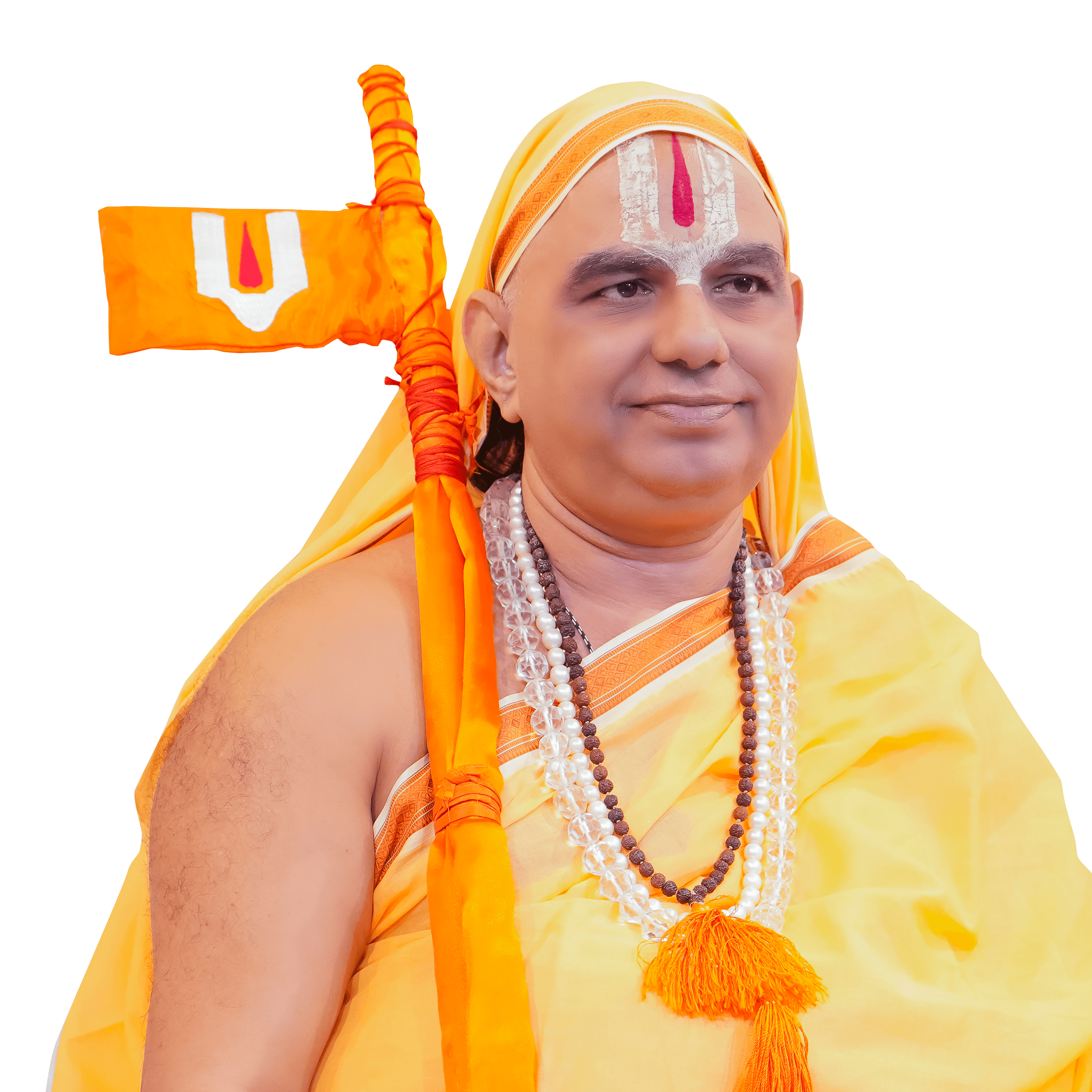
Philosophical Realization
Transition towards Philosophical Realization
Upon examining the entire life journey described above, it becomes evident that the work of Jagadguru Shrimad Ramanandacharya Narendracharya is not merely biographical or institutional in nature; rather, it represents the living embodiment of a systematically structured philosophical doctrine. From birth and the early inclination towards spirituality in childhood, unwavering devotion to Sant Gajanan Maharaj, discipleship under Samarth Sadguru Kadsiddheshwar Maharaj, the renunciation of employment in 1992 in obedience to the Guru’s command, the establishment of the Swa-Swaroop Sampradaya, and ultimately ascending to the पद of Jagadguru Ramanandacharya in 2005—these events collectively reveal a continuous and coherent philosophical stream. This philosophical stream is precisely the Vishishtadvaita-based, Guru-centric Doctrine of Self-Realization. Within this philosophical vision, God is omnipresent; the individual soul exists within His divine substratum; the universe is pervaded by divine consciousness; and the Sadguru serves as the living medium through which the realization of this divine principle is experienced. Therefore, within his thought system, the Guru principle, self-realization, devotion, service, righteous conduct, spirituality within worldly life, and the vision of universal oneness are not isolated concepts but interrelated and complementary components of a unified science of life. A detailed, systematic, and experiential exposition of this philosophical stream is presented in the following section.
The Philosophical Vision of Jagadguru Shrimad Ramanandacharya Narendracharya
Jagadguru Shrimad Ramanandacharya Narendracharya has established a distinctive philosophical foundation within the sphere of modern spiritual thought. The central focus of his philosophy is not limited to traditional devotion, sectarian identity, or ritualistic worship; rather, it is centered upon Guru-centric self-realization, the awakening of divine consciousness within all humanity, the integration of devotion, service, and righteous conduct, and a life-orientation that enables the pursuit of spiritual fulfillment while remaining engaged in worldly life. His philosophical framework reflects a unique synthesis of scripture, spiritual practice, the Sadguru principle, service, a scientific outlook, and direct experiential realization.
1. Guru-centric Doctrine of Self-Realization :
The fundamental basis of Jagadguru’s philosophical system is the “Guru-centric Doctrine of Self-Realization.” According to his teachings, the ultimate purpose of human life is not external success, sensory enjoyment, position, or prestige, but the realization of one’s true Self. This realization cannot be attained merely through intellectual reasoning or ritualistic practices; it is achieved through the grace of the Sadguru and the awakening of inner consciousness. Therefore, within his philosophy, the Guru is not merely an instructor, but a revealer of vision who leads the seeker towards the realization of the true Self.
2. Non-dual and Non-discriminatory Spiritual Vision :
A distinctive feature of his spiritual philosophy is that he regards distinctions based on caste, class, gender, wealth, or social status as secondary from the standpoint of the Self. According to his vision, the essential nature of the individual is not body-centered but consciousness-centered. Consequently, he does not confine spirituality within any form of social elitism; rather, he makes it universally accessible to all. This perspective is not merely a message of social equality, but a profound assertion of the universality of the Self.
3. Practical Attainability of Self-Realization :
While many saints and spiritual teachers speak about liberation, knowledge, or God-realization, Jagadguru Shrimad Ramanandacharya Narendracharya instilled a firm conviction that self-realization is not merely a theoretical or distant ideal, but an attainable experiential reality. As a result, in his teachings, spirituality does not remain limited to inspirational discourse; it becomes a truth that can be lived and embodied in everyday life. This stance imparts to his philosophy a distinctly experiential and demonstrative character.
4. “Live Yourself, Help Others Live”: The Spiritual Vision of Human Life :
His well-known maxim— “Live yourself, help others live”—is not a simple social statement but a profound spiritual principle. According to his teaching:
-
“Live yourself” signifies realizing one’s true nature, inner consciousness, and divine substratum.
-
“Help others live” means awakening self-awareness in those who have become disconnected from their true nature due to ignorance, and activating the dormant consciousness within them.
Thus, this principle does not merely convey a message of coexistence or mutual support; rather, it defines a twofold spiritual responsibility—self-realization and the awakening of others.
5. “God Resides in Every Atom”: The Concept of Divine Omnipresence :
The principle articulated by Jagadguru Shrimad Ramanandacharya Narendracharya— “God resides in every atom”—forms a crucial foundation of his philosophical system. According to this concept, God is not confined to temples, idols, scriptures, or ritualistic practices; instead, He pervades every particle of the entire cosmos. This perspective represents a living synthesis of the non-dual vision of universal oneness, the Vishishtadvaita conception of a divinely sustained universe, and the experiential dimension of devotional realization.
6. Not Merely Articulated but Lived: The Experiential Embodiment of “God in Every Atom” :
A distinctive feature of the spiritual philosophy of Jagadguru Shrimad Ramanandacharya Narendracharya is that the principles he expounded did not remain confined to textual exposition or verbal instruction; rather, they were manifested in his life through direct practice and lived experience. The concept “God resides in every atom” was not merely an intellectual construct for him; it was a truth grounded in experiential realization. According to this realization, the Supreme Being is not limited to any singular form; rather, He is the Absolute Reality that pervades every particle of the entire cosmos. Transcending limitations of specific embodiment, time, or form, he perceived the Divine as all-pervasive consciousness.
Within this context, his reverence towards Sant Gajanan Maharaj assumes particular significance. In his view, Sant Gajanan Maharaj was not merely a historical saint or an object of devotional sentiment; rather, he represented a living, accessible, and experiential embodiment of that all-pervasive Supreme Reality. A subtle yet significant distinction must be understood here—the position of Jagadguru Shrimad Ramanandacharya Narendracharya does not negate distinctions among deities; rather, it affirms the realization of one and the same Supreme Reality (Parabrahman) in all deities. In accordance with the Mahavakya “Sarvam Khalvidam Brahma” (Chandogya Upanishad 3.14.1), the entire universe and all divine forms are expressions of the one Supreme Reality. According to Narendracharya, whether it is Rama, Krishna, Vishnu, Shiva, or the Divine Mother, the same attributeless, dynamic, and all-pervasive Brahman manifests through these various forms, and that very principle is also revealed in the form of realized saints. Therefore, although at the empirical (Vyavaharika) level different deities may appear distinct, at the transcendental (Paramarthika) level they are all diverse manifestations of the same Supreme Reality.
This vision of unity ensures that no contradiction arises in his personal spiritual practice. The realization of one Supreme Reality in all deities aligns with Advaita Vedanta, while being firmly grounded in the framework of Vishishtadvaita. Indeed, the experiential recognition of one truth through multiple forms constitutes the very essence of his spiritual path. Consequently, in the saintly form he inwardly embraced—Sant Gajanan Maharaj—he perceived the presence of that Supreme Reality and continues his uninterrupted devotion in that spirit. Thus, there is neither any disregard for any deity nor any selective insistence; rather, the Vedantic principle— “One Supreme Reality manifesting in multiple forms”—is translated into lived experience. As a result, his spirituality does not remain confined within narrow frameworks of worship, but assumes a three-dimensional character:
-
Philosophically non-dual in orientation,
-
Devotionally steadfast and dedicated,
-
Experientially dynamic and living.
“Though the forms of deities are many, the substratum is one; that form in which the realization of the Supreme Reality is experienced becomes the object of worship for the seeker.”
Importantly, even after being enthroned as an Acharya within the Ramanandi tradition in 2005, he never altered his foundational devotional allegiance. While Lord Rama is revered as the principal deity within the Ramanandi tradition, his inner devotion toward Sant Gajanan Maharaj remained constant and unwavering. This position does not reflect any contradiction; rather, it is a consistent expression of his philosophical conviction. According to his view, the Supreme Reality is one, and just as it is realized through the forms of Rama and other deities, it is equally experienced through the form of Sant Gajanan Maharaj.
7. The Principle of the Sadguru as the Divine Reality :
Within the Vishishtadvaita-oriented philosophical framework of Jagadguru Shrimad Ramanandacharya Narendracharya, the principle of the Sadguru occupies a central and indispensable position. According to his teaching, if one seeks to recognize the divine essence within the individual being, a Sadguru—who imparts the vision for such realization—is essential. He therefore firmly asserts that the Sadguru is the living embodiment of the Supreme Reality on earth. This statement does not advocate personality worship; rather, it establishes the indispensable role of the Guru’s grace in the process of self-realization. In his view, self-realization is virtually unattainable without the grace of the Guru.
8. Service to All Living Beings :
In his philosophy, service is not a secondary aspect of spiritual life; rather, it is regarded as the very life-force of devotion to God. Service to all living beings is, in essence, service to the Divine—this is his firm conviction. This outlook is not confined to a human-centered perspective but extends to all forms of life, and is grounded in compassion, selfless dedication, and the vision of universal oneness.
This perspective finds strong support in the Upanishadic tradition. The Ishavasya Upanishad declares:
“Yas tu sarvani bhutani atmani evanupasyati,
Sarva-bhutesu catmanam tato na vijugupsate”
(Mantra 6)
According to this teaching, the seeker who perceives all beings within the Self and experiences the Self within all beings does not harbor aversion toward anyone. From this realization of universal oneness, service transcends mere compassion or duty and becomes a direct expression of devotion to the Divine. Thus, service to all living beings emerges, within his philosophical system, as the practical manifestation of the Upanishadic vision of unity.
9. Devotion, Service, and Conduct: The Triad for God-Realization :
According to Jagadguru Shrimad Ramanandacharya Narendracharya, the attainment of the Supreme Reality is not possible without the integrated practice of devotion, service, and righteous conduct. The realization of one’s true nature, self-knowledge, or liberation cannot be achieved merely through intellectual deliberation or theoretical discourse. It requires purity of heart, moral refinement of life, and sincerity of inner feeling.
-
Devotion must be practiced with inner purity; external formalities, ritualistic rigidity, or ostentation do not hold ultimate value.
-
Service must be rendered with sincerity; instead of claiming personal credit, it should be offered to the Guru as the embodiment of the Divine. Only then does service transform into true altruism.
-
Conduct must be sattvic; as the influence of rajas and tamas diminishes and inner purity increases, the groundwork for detachment, dispassion, and self-knowledge is established.
This triad constitutes the practical framework of his spiritual science of life.
10. Surrender to a Self-Realized Master for Liberation :
According to his teaching, liberation can be attained only through surrender to a self-realized enlightened master. However, such surrender must not be based on blind imitation. Before accepting a Guru, one must ascertain whether the Sadguru embodies self-realization, authentic Guru-consciousness, and scriptural authority. Only after attaining inner conviction that such a Guru is indeed the bestower of ultimate liberation should, one offer complete surrender. Thus, within his tradition, devotion to the Guru exists, but it is not devoid of discernment; rather, it is grounded in experience, evaluation, and firm conviction.
11. Spiritual Realization within Worldly Life :
Jagadguru Shrimad Ramanandacharya Narendracharya did not advocate a one-sided renunciation of worldly life; instead, he presented a life-orientation centered on “pursuing spiritual realization while remaining engaged in worldly duties.” According to the doctrine of karma, the individual soul enters worldly life, and without experiencing the consequences of these actions, the process of self-realization remains incomplete. This perspective offers a balanced alternative to renunciation-centric spirituality by establishing a harmonious integration of household life and spiritual pursuit. As a result, spirituality becomes accessible and attainable even for the common householder.
12. Integration of Science and Spirituality :
Jagadguru Shrimad Ramanandacharya Narendracharya articulated a highly refined threefold principle—“Eyes scientific, mind spiritual, and intellect realistic.” Within this single statement lies a balanced framework for modern human life.
-
Eyes scientific — signifies observation, factual accuracy, inquiry, and objectivity.
-
Mind spiritual — signifies values, compassion, introspection, and sensitivity to the Divine.
-
Intellect realistic — signifies practical wisdom, integration, and balanced decision-making.
Through this triadic formulation, he harmonized spirituality with rationality, safeguarding spirituality from superstition and science from insensitivity, thereby creating a constructive synthesis between the two.
13. Devotion in the Vernacular and Acceptance of Modern Media :
He did not confine devotion within the traditional boundaries of monasteries and temples; rather, he expanded its reach through vernacular language, literature, prose, poetry, and modern digital media. According to him, devotion is not merely an emotional expression but a disciplined exercise in mental concentration. Therefore, he regarded literary creation, devotional compositions, discourses, and modern communication platforms as instruments for refining the mind. This approach reflects a harmonious integration of traditional spirituality with contemporary modes of communication.
14. Guru Devotion, Detachment, and Practical Living :
A deeply significant aspect of his life is his unwavering devotion toward his chosen deity and Sadguru. He maintained a level of devotion toward Sant Gajanan Maharaj comparable to the fidelity of a devoted consort. He considered himself as a mere servant at the feet of Gajanan Maharaj—this expression of devotional servitude stands as a testament to the depth of his inner surrender and spiritual dedication.
His unwavering obedience to the command of Samarth Sadguru Kadsiddheshwar Maharaj was truly exceptional. At the young age of merely twenty-five, despite having a young wife, a small child, and a stable job, he resigned from his employment immediately upon the Guru’s instruction. This incident stands as a vivid example of his absolute fidelity to the Guru’s word.
Within a few months, through the grace of the Guru, a mature state of detachment developed within him. The world began to appear transient, and his resolve to renounce worldly life became firm. However, at that very moment, upon the request of his wife, the Sadguru instructed him to pursue spiritual realization while remaining in worldly life. He upheld this command throughout his lifetime. Like a lotus that remains in water yet untouched by it, his life reflects detachment amidst engagement. Outwardly a householder, yet inwardly unattached—this became the unique point of equilibrium in his life.
Even in 2005, when the occasion arose for him to be enthroned as Jagadguru, he clearly stated that while Bhagavan Ramanandacharya was a renunciate, he himself was a householder and would not accept renunciation against the command of his Sadguru. For him, the command of the Guru held greater authority than even the position of Jagadguru. This stance was not merely an expression of humility, but a declaration of the supreme primacy of the Guru principle. Therefore, he does not merely preach spirituality; he demonstrates it through the lived example of his own life.
15. Unchanged Devotion Even After Attaining the Position of Jagadguru :
Even after being enthroned as Jagadguru, Jagadguru Shrimad Ramanandacharya Narendracharya did not alter his devotion and surrender toward his chosen deity, Sant Gajanan Maharaj, and his Sadguru, Samarth Sadguru Kadsiddheshwar Maharaj. He continues to remain deeply reverential at their feet. His devotional compositions clearly reflect the spirit of servitude toward the Guru, unwavering dedication to the Supreme, complete surrender, and an unbroken inner longing. This demonstrates a harmonious unity between his poetic devotion and his philosophical commitment.
The philosophical vision presented in this work is not confined to any single sect; rather, it emerges as an integrative spiritual framework aligned with the broader foundation of the Vedic and Vedantic tradition. Its central themes—the realization of one’s true Self, the importance of the grace of the Sadguru, the integration of devotion, service, and righteous conduct, and the pursuit of spiritual fulfillment while remaining engaged in worldly life—are all coherently connected with the Vedic vision of an all-pervading Divine, the Upanishadic doctrine of the unity of the Self and Brahman, and the Vedantic path to liberation.
The Vedic principle that “the Divine pervades all,” the Upanishadic realization of the unity between the Self and Brahman, and the Vedantic path of spiritual practice leading to liberation—this triadic framework finds a practical and experiential expression within this philosophical system. The principles such as “God resides in every atom,” “service to all living beings,” and the triad of “devotion, service, and conduct,” along with the centrality of the Guru principle, all emerge as living manifestations of core Vedantic teachings. Similarly, the emphasis on purity of conduct, discipline, and regulated living—highlighted in the auxiliary Vedic sciences—is reflected at a practical level within these teachings. Furthermore, through the triad of scripture, Guru, and self-experience, a balanced integration of knowledge, realization, and conduct is achieved.
Thus, upon examining the characteristics presented in this chapter, it becomes evident that this philosophical stream is not separate from the Vedic–Vedantic tradition; rather, it represents its modern, life-oriented, and experiential expression. Consequently, this philosophy does not remain merely conceptual; it emerges as a comprehensive spiritual science of life that leads the individual toward the realization of the true Self while simultaneously guiding society toward a harmonious and ethically refined direction.